Archiwum kategorii ‘Wydawnictwa’

kwi
06

Kontynuacja odcinka 69

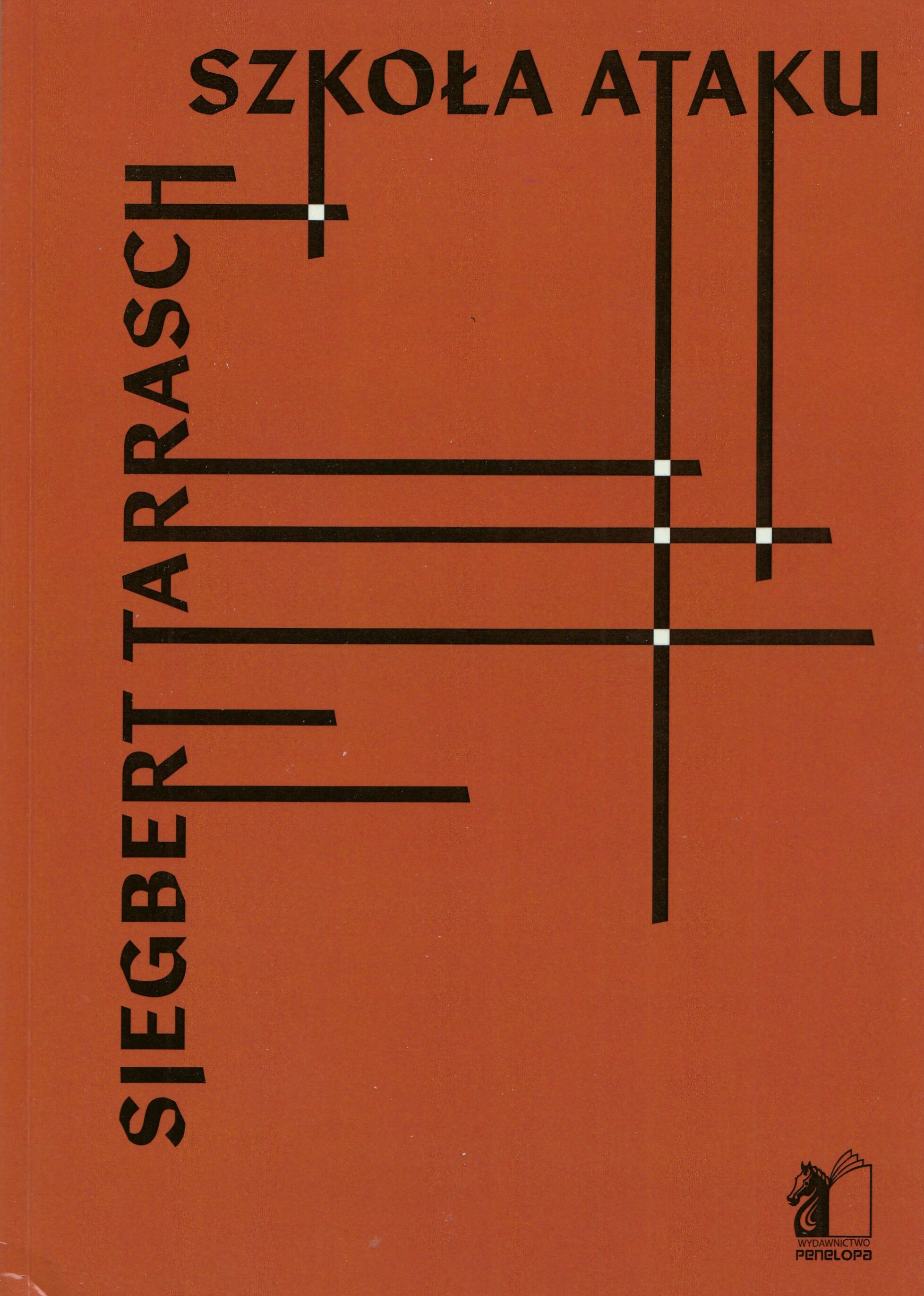
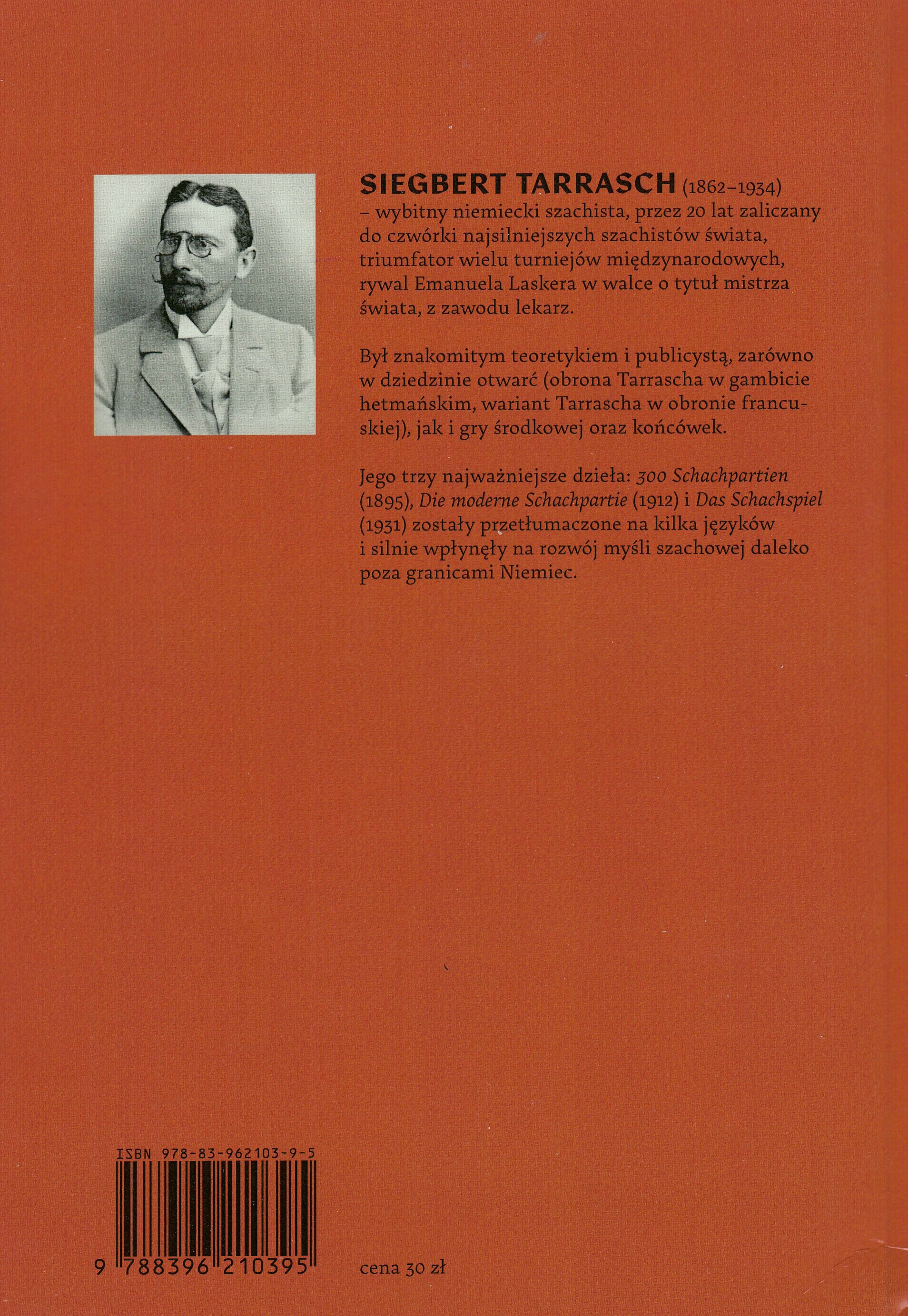
Niedawno dzięki wydawnictwu Penelopa ukazała się polska edycja znanego dzieła wybitnego niemieckiego szachisty Siegberta Tarrascha pt. „Szkoła ataku”.

Książka ukazała się po raz pierwszy w 1931 roku i doczekała się kilku wydań w Anglii, USA i nawet Związku Radzieckim.

Jest to znakomity podręcznik (116 stron) dla początkujących zawodników oraz trenerów!

Intryguje mnie okładka. Co ona przedstawia?


kwi
05
Recommended for club players View this email in your browser
Dear Chess Friend,

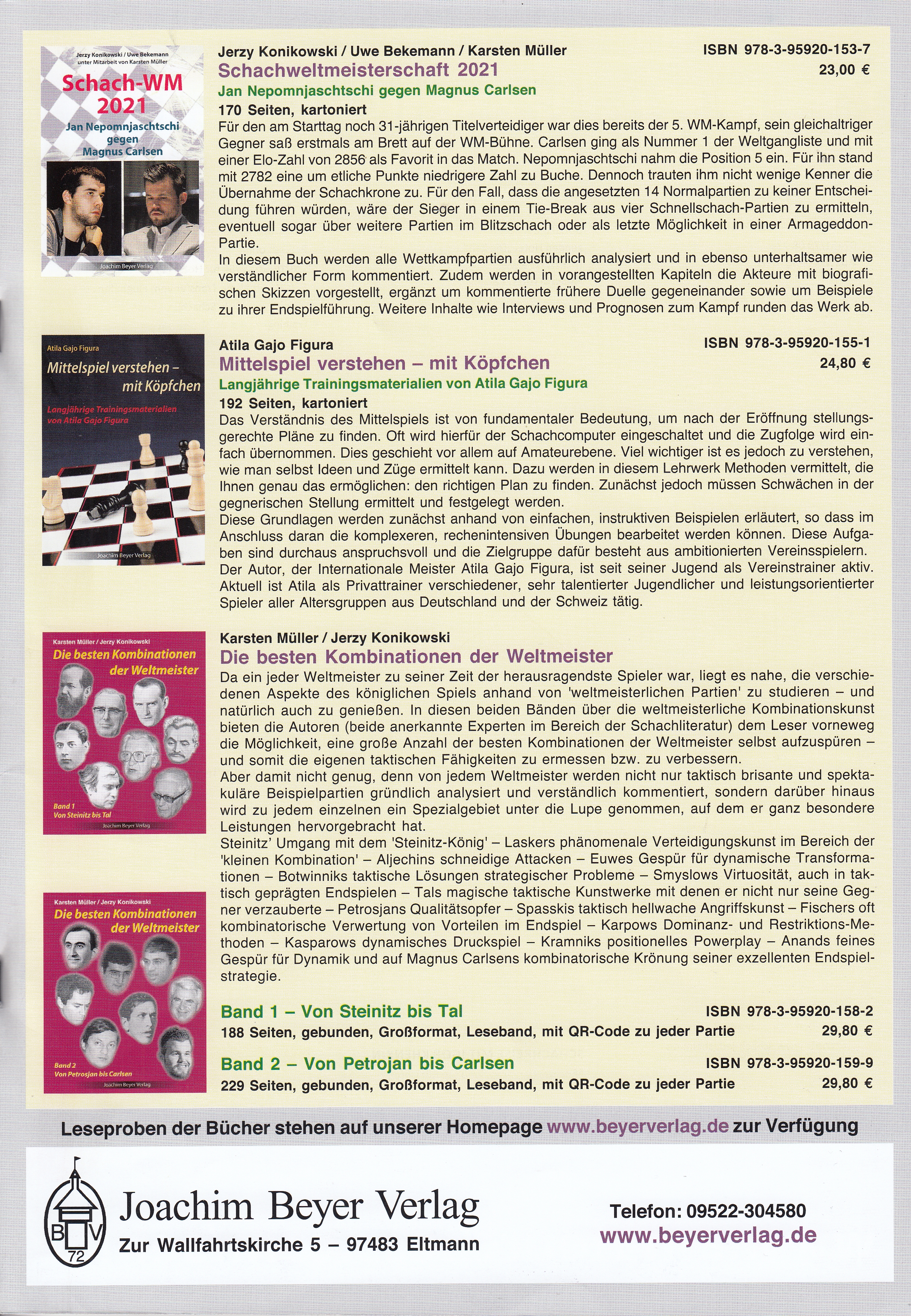
Now available: The Best Combinations of the World Champions – Volume 1: From Steinitz to Tal.

Since every world champion was the most outstanding player of his time, it makes sense to study the various aspects of the royal game using the world champions’ games – and of course to enjoy them!

In this first of two volumes on the world champions’ art of combination, Karsten Müller and Jerzy Konikowski offer you the opportunity of trying to find plenty of these best combinations yourself – and thus to assess and improve your own tactical skills.

Position from Tal – Voorema after 33. … Qb5
How did Tal force immediate resignation? You can find the solution in the sample pages.

But that’s not all. In addition to these often breathtakingly spectacular games, which are thoroughly analyzed and commented on in a comprehensible way, individual pet topics are highlighted in which the world champions have created particularly outstanding works.

Take a closer look at:
♚ how Steinitz handled the 'Steinitz King’
♚ Lasker’s phenomenal art of defense
♚ Capablanca’s mastery of 'petite combinaison’ (small combinations)
♚ Alekhine’s dashing attacks
♚ Euwe’s seventh sense for dynamic transformations
♚ Botvinnik’s tactical solutions to strategic problems
♚ Smyslov’s virtuosity even in tactical endgames
♚ Tal’s downright magical tactical works of art

Just like in the Best Endgames of the World Champions series, you can use the QR codes that are placed next to the diagrams to replay the games on your device while reading the physical book.

Please have a look at this rich collection of World Champion combinations. Volume 1 contains 260 combinations and many fully annotated sample games. Do check out the 18 sample pages in the shop to get a good feel of the book.

Best wishes,Sebastiaan Smits
New In Chess

kwi
01

Pismo, które jest organem  Niemieckiego Związku Gry Korespondencyjnej, zawiera wiele informacji o turniejach drogą pocztową oraz emailową, uzupełnione jest także ciekawymi partiami oraz tematycznymi artykułami.

Z „Fernschachpost” współpracuję  od 2008 roku i głównie zajmuję się teorią debiutów. W swoich artykułach staram się zwracać uwagę na ciekawe idee i zachęcić do dalszej pracy badawczej nad poszczególnymi zagadnieniami. Bardzo często na bazie moich przemyśleń organizuje się turnieje tematyczne, które w istotny sposób wzbogacają wiedzę o różnych wariantach.

W tym numerze przedstawiłem jeden z wariantów obrony dwóch skoczków (C57). 

mar
26

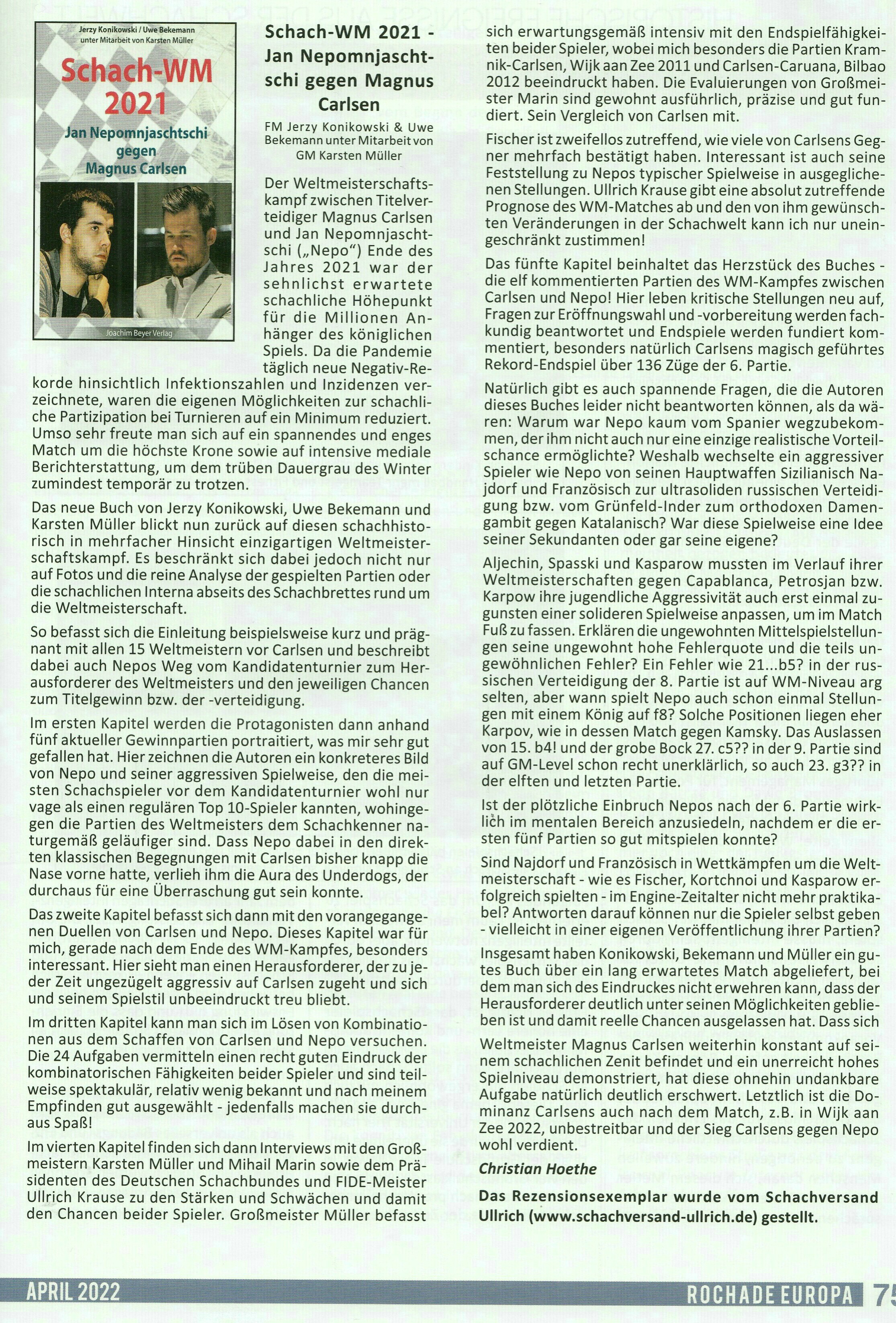
W najnowszym piśmie „Rochade Europa” 4-2022 ukazała się recenzja książki Schach-WM 2021.

Wersja angielska

„Rochade Europa” jest najpopularniejszym miesięcznikiem szachowym w Niemczech i na swoich łamach reklamuje tylko najbardziej wartościowe pozycje w rodzimym języku.

mar
15

Kontynuacja odcinka 68

Dla czytelników książki

Mistrzowie Polski w szachach 1926-1978

mam pomyślną wiadomość: 2 część (lata 1979-2021 i 341 stron) jest już w drukarni.

Informacja na stronie wydawnictwa CAISSA: www.szachysklep.com.pl

lub https://www.szachysklep.com.pl/


mar
10

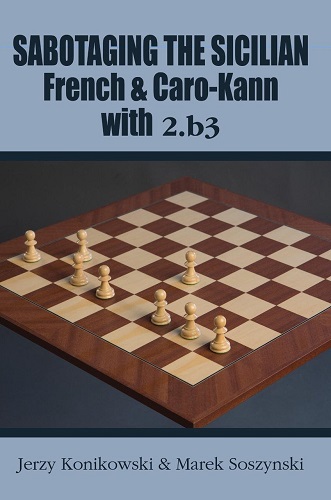
Sabotaging the Sicilian, French & Caro-Kann with 2.b3

leave a comment »

Sabotaging the Sicilian, French & Caro-Kann with 2.b3

By Jerzy Konikowski and Marek Soszynski

Russell Enterprises, 2018

ISBN: 9781941270837

One for flaneurs who like to meander.

If you play 1.e4 and are not averse to veering off into an infrequently frequented sideline when meeting various semi-open games, then this book may well be for you. It looks at lines involving the fianchetto of the queen’s bishop, an unusual sidestep in connection with 1.e4, but there we are.

We start with the Sicilian (1.e4 c5 2.b3), which is covered in section 1, chapters 1 to 8. There are 20 annotated games featuring , on the white side, the likes of Spassky, Kramnik, and Carlsen. This approach has a excellent pedigree, clearly, and on the evidence presented here tends to lead to interesting , complex middlegame positions. Let us say that Black tries to close down the long diagonal (a1-h8) with 2…Nc6 3Bb2 e5 (say). White can then seize the newly weakened diagonal (a2-g8) with 4.Bc4 or, alternately, try to prise the other diagonal open with 4.f4. Or indeed, he could pursue both goals. Tamaz Gelashvili, the Georgian grandmaster, is a great specialist in this line.

To the French now (1.e4 e6 2.b3), the focus of section 2, chapters 9-15, though with a mere five annotated games this time (a reduction of 75% I note). Pride of place here goes to the so-called Reti Gambit (1.e4 e6 2.b3 d5 3.Bb2 dxe4) although it is only a genuine gambit if Black defends the pawn with a pawn (4.Nc3 f5), a line known as the Gurevich Defence. Now 5.f3 Bd6! can lead to interesting complications. There is a fine attacking game by Luke McShane here which put me in mind of Carlsen’s game against Wojtaszek at Shamkir 2018. In both, you have an open Sicilian pawn structure (the moves d4 and …cxd4 have occurred) with White castled queenside, his king position fortified by the bishop on b2. A line that would be worth an occasional run out, I would say. Why not?

But the same cannot be said, alas, for  2.b3 against the Caro-Kann, which happens to be the subject of section 3, chapters  16-21. Here the analysis is accompanied by 5 annotated games and, despite one of these games being an exciting, epic encounter between Vasiukov and Bronstein, you would have to say that, realistically, the line only offers white equality. On 2…d5 3.Bb2 dxe4 4.Nc3 Nf6 5.Qe2 Bf5 (or maybe 5…Bg4) Black holds the pawn pretty easily and obtains a comfortable position. Yes, White can probably get it back if he goes 5.Ne2 (the plan being Ng3 and then Qe2) but I mean, really, is this how you want to be playing as White? White is just scampering to regain the pawn, not playing for an advantage, will obtain at best a position with few prospects. Not a good outcome for White.

As an afterthought (or postscript) the authors, Jerzy Konikowski and Marek Soszynski, look at the Scandinavian: 1.e4 d5 2.b3 (and not 2.exd5 Qxd5 3.b3? Qe5+ with disaster) dxe4 3.Nc3 Nf6 4.Qe2 when the best move is 4. …Nc6! and …Nd4 gives Black an advantage. My advice to white players: don’t do it!

So what is the verdict? Well, 2.b3 is a move that must be employed with judicious care; it is a bit of a slippery slope. To summarise briefly. 2.b3 is splendid versus the Sicilian ,whilst it can be frenetic (unduly forcing) against the French. It is mite concerning if not exactly crippling when essayed against the Caro-Kann. But the big no-no: it is as suicidal as an Ingmar Bergman character if played as a response to the Scandinavian. Desist!

The publisher’s description of the book is here.

mar
04

The Reti Opening: Properly Played

leave a comment »

The Reti Opening: Properly Played

By Jerzy Konikowski and Uwe Bekemann

Joachim Beyer Verlag, 2019

ISBN: 9783959209809

The right way to play the Reti.

This useful monograph surveys white’s principal lines of play following the moves 1.Nf3 d5. It is clear that white’s most convincing move here is 2.c4, but before moving on to that the authors cover both 2.g3 (in Chapter 1) and 2.b3 (Chapter 2). It is a bit dull, in truth, 2.g3, unless white plays a later c4. But 2.b3 can lead to lively positions.

After 2.c4, black can respond with 2…d4 (covered in Chapter 3), 2…e6 (Chapter 4) or 2…dxc4 (Chapter 5); however, the most common response nowadays is the Slav-like 2…c6.

Our options as white now are 3.b3 (dealt with in Chapter 6; and this move can lead, as when played on move two, to rich and lively positions), 3.e3 (examined in Chapter 7: an interesting approach that can give rise to strategically complex, Hedgehog like positions), and 3.g3 Nf6 4.Bg2, which is the main line.

On 4.Bg2, black has several possibilities, chief among them being 4…Bf5 (Chapter 8), 4…Bg4 (Chapter 9), 4…e6 (Chapter 10) and 4…g6 (Chapter 11). These four moves, while different in approach, are of about equal worth. If followed up correctly, they all should more or less equalise.

All told, I found the theoretical material (briefly summarised above) to be clearly presented and accompanied by a full, forensic analysis. Each chapter closes with some helpful concluding remarks.

In addition to the theory of the opening, there are 31 illustrative games in the final chapter, Chapter 12, including victories by Reti himself, as well as fine wins by world champions Carlsen, Kramnik, Botvinnik, and Capablanca. Most of these games are positional or strategic in nature, quite in keeping with the spirit of the Reti, but there are a few wild and wonderful creatures as well. Of these, I would point you toward Capablanca-Bogoljubov, Moscow 1925 (game 17) and Ivanchuk-Alekseyev, Jermuk 2009 (game 3) as radiant exemplars. In general, the annotations are along the lines of strategic explanations of the play, and they are very lucid at that, but when needed there is heavy duty analysis, intricate in detail.

From the assembled theoretical material, white can eke out a fair number of lines of play. For example, white could employ the line 1.Nf3 d5 2.b3; or 2.c4 c6 3.e3; or the main line 3.g3 Nf6 4.Bg2. But note that moves other than 1…d5 are not covered in this book. So if you intend to play 1.Nf3 and want to know how to meet 1…c5, 1…Nf6 (maybe angling for the King’s Indian Defence), or 1…f5, you need to look elsewhere. If you are in this quandary, I would recommend Nigel Davies’s The Dynamic Reti. Although somewhat dated (it first came out in 2004), it is an excellent repertoire book and even today his recommendations hold up well. It is helpful, in this connection, that there are few critical lines in the Reti, situations where white is called upon to burn his bridges.

Now for a few concluding remarks of my own. There is no clearly best approach by white in the Reti, it would seem, since black can equalise with accurate play against virtually anything that is thrown at him. Though, having said that, the path to equality will sometimes narrow slightly. So white should aim to sculpture a middlegame that will give rise to complicated strategic play. The comprehensive treatment of the opening in The Reti Opening: Properly Played, where it is properly presented and analysed, will furnish the reader with the tools to do just that.

The publisher’s description of The Reti Opening: Properly Played is here.