lut
13


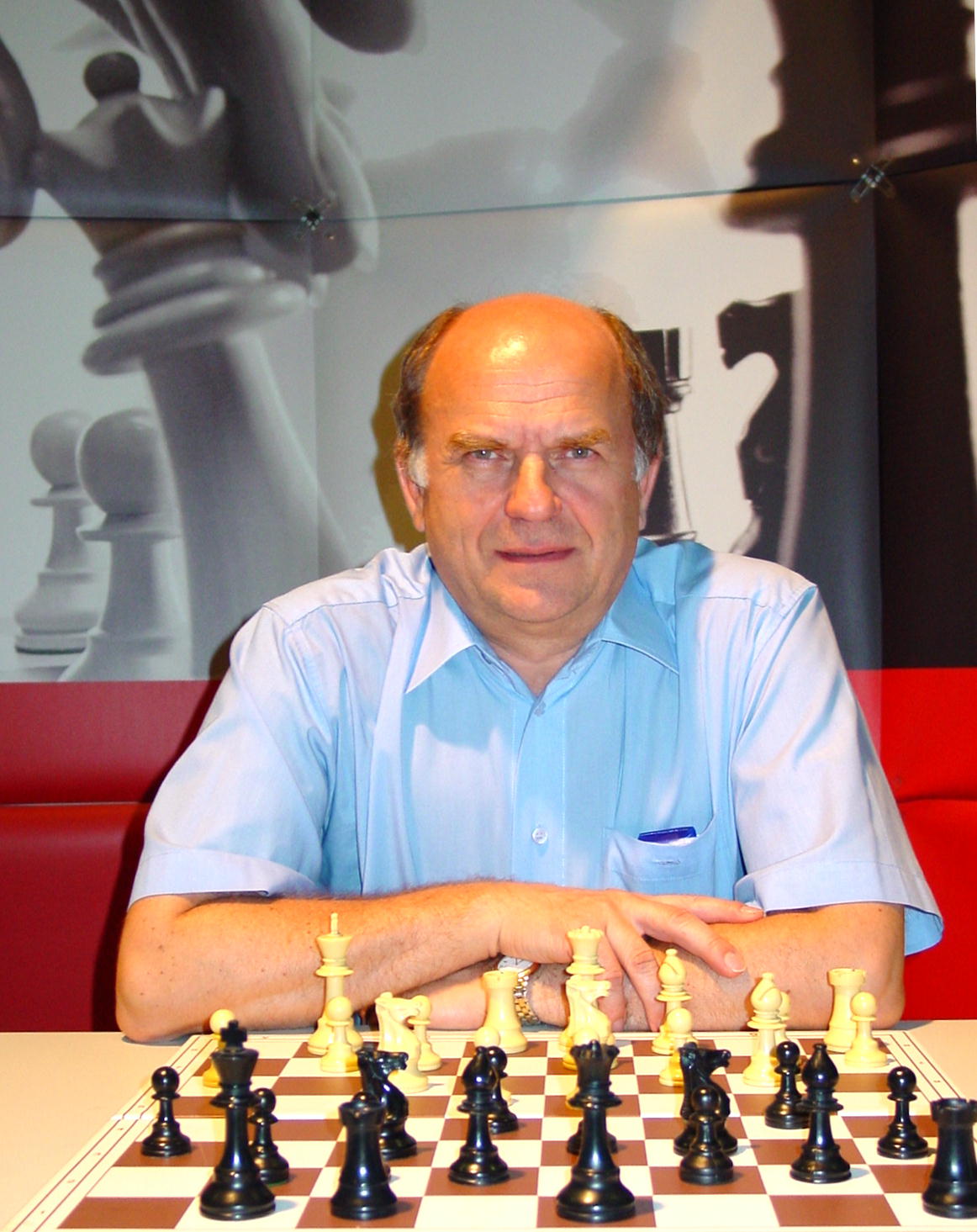
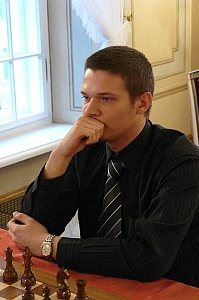
W dniach 03-10 lutego w Płowdiw odbył się 35. Memoriał Gergi Trigonova. W turnieju grał arcymistrz Bartłomiej Heberla, który zajął 2 miejsce.
Czołówka
| M-sce | Nazwisko | Kraj | Elo | Pkt | ||
| 1 | GM | Fier Alexandr | BRA | 2577 – | 8.5 | |
| 2 | GM | Heberla Bartłomiej | POL | 2545 – | 7.5 | |
| 3 | GM | Djukic Nikola | MNE | 2537 – | 7.0 | |
| 4 | GM | Jianu Vlad-Cristian | ROU | 2500 – | 7.0 | |
| 5 | GM | Vasilev Milen | BUL | 2473 – | 7.0 | |
| 6 | GM | Cheparinov Ivan | BUL | 2709 – | 7.0 | |
| 7 | GM | Grigorov Grigor | BUL | 2513 – | 7.0 | |
| 8 | GM | Petrov Marijan | BUL | 2518 – | 7.0 | |
| 9 | Danov Lyubomir | BUL | 2158 – | 7.0 | ||
| 10 | GM | Spasov Vasil | BUL | 2567 – | 7.0 | |
| 11 | GM | Nedev Trajko | MKD | 2505 – | 7.0 | |
| 12 | IM | Rombaldoni Axel | ITA | 2472 – | 7.0 | |
| 13 | GM | Paichadze Luka | GEO | 2520 – | 7.0 |
Wyniki indywidualne Heberli
| Nazwisko | Heberla Bartłomiej |
| Tytuł | GM |
| Lista startowa | 6 |
| Ranking krajowy | 0 |
| Elo | 2545 |
| Wynik rankingowy | 2653 |
| FIDE rtg +/- | 17.4 |
| Punkty | 7.5 |
| M-sce | 2 |
| Federacja | POL |
| Nr identyfikacyjny | 0 |
| Fide ID | 1115120 |
| Rd | Szach | SNr | Nazwisko | Elo | Fed | Pkt | Wyn. | |
| 1 | 6 | 144 | Kartalov Kiril | 1824 | BUL | 2.5 | s 1 | |
| 2 | 6 | 79 | Deac Bogdan-Daniel | 2117 | ROU | 5.5 | w 1 | |
| 3 | 6 | 47 | Kjurkchiiski Georgi | 2267 | BUL | 6.0 | s 1 | |
| 4 | 5 | 27 | FM | Georgescu Tiberiu-Marian | 2396 | ROU | 6.5 | w 1 |
| 5 | 4 | 11 | GM | Petrov Marijan | 2518 | BUL | 7.0 | s 1 |
| 6 | 1 | 3 | GM | Fier Alexandr | 2577 | BRA | 8.5 | w ½ |
| 7 | 2 | 17 | GM | Vasilev Milen | 2473 | BUL | 7.0 | s ½ |
| 8 | 2 | 8 | GM | Djukic Nikola | 2537 | MNE | 7.0 | w 1 |
| 9 | 2 | 1 | GM | Cheparinov Ivan | 2709 | BUL | 7.0 | s ½ |
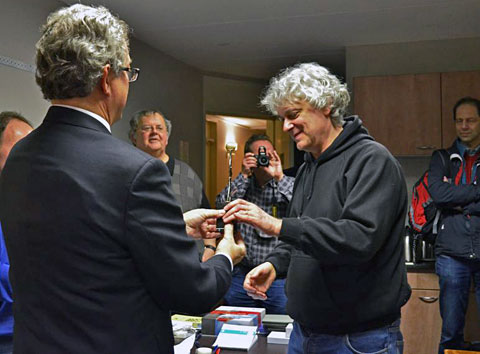
W trakcie arcymistrzowskiego turnieju w Wijk aan Zee odbył się konkurs w rozwiązywaniu studiów szachowych „4th Tata Steel Studies Solving Competition”.
W znakomitej formie okazał się angielski arcymistrz John Nunn, który uzyskał 43 punktów z 45 możliwych.
Końcowe wyniki
|
M-ce
|
Zawodnik |
Kraj
|
Punkty
|
Czas
|
|
1
|
John Nunn |
GBR
|
43
|
(2:15)
|
|
2
|
Piet Peelen |
NED
|
39
|
|
|
3
|
Guus Rol |
NED
|
37
|
|
|
4
|
Joost Michielsen |
NED
|
36
|
(2:55)
|
|
5
|
Piotr Murdzia |
POL
|
36
|
|
|
6
|
Oleg Pervakov |
RUS
|
35
|
|
|
7
|
Wouter van Rijn |
NED
|
33
|
(2:57)
|
|
8
|
Alina L’Ami |
ROM
|
32
|
|
|
9
|
Martin van Essen |
NED
|
30
|
|
|
10
|
Harold van der Heijden |
NED
|
29
|
(2:52)
|
|
11
|
Dolf Wissmann |
NED
|
28
|
(2:58)
|
|
12
|
Willem van Briemen |
NED
|
27
|
|
|
13
|
Hans Uitenbroek |
NED
|
26
|
|
|
14
|
Marcel Van Herck |
NED
|
25
|
|
|
15
|
Ryszard Królikowski |
POL
|
23
|
|
|
16
|
Migchiel de Jong |
NED
|
22
|
(2:59)
|
|
17
|
Evgeny Kopilov |
RUS
|
21
|
(2:50)
|
|
18
|
René Olthof |
NED
|
20
|
|
|
19-20
|
Jesús M. Sedante |
ESP
|
19
|
|
|
19-20
|
Marcin Kołodzienski |
POL
|
19
|
|
|
21
|
Harm Benak |
NED
|
18
|
|
|
22
|
Antti Parkkinen |
FIN
|
13
|
|
|
23
|
Jan Baljé |
NED
|
11
|
(2:51)
|
Większość z nas powie, że jakie szachy są, każdy wie. Czy jednak rzeczywiście to stwierdzenie jest prawdziwe? Okazuje się że nie, gdyż wśród osób nie związanych z szachami panuje raczej fałszywy wizerunek tej gry. Szachy obrosły wieloma mitami, przy czym większość z nich jest krzywdząca dla wizerunku tej gry. Klasycznym przykładem błędnej i bardzo denerwującej „łatki” jest przysłowiowy już „refleks szachisty”. Autorzy poniższych artykułów starają się rozprawić z różnymi szachowymi mitami:
Krzysztof Kledzik

Od kilku lat posiadam mosiężną odznakę szachową, przypinaną na agrafkę. Osoba która mi ją przekazała twierdziła, że jej pierwotnym właścicielem był estoński arcymistrz Jaan Ehlvest. Takie odznaki miały być rozdawane na turniejach szachowych sponsorowanych przez firmę Intel. Czy ktoś z Czytelników orientuje się, czy tak rzeczywiście było?
Krzysztof Kledzik

Dear chess friends,
Below you can find the official Round 5 Report on the GRENKE Chess Classic in Baden-Baden. Please feel free to use this report and the accompanying photos on your own websites, but please link to the official website (http://www.grenkechessclassic.com) and credit Georgios Souleidis for the photos and myself (Colin McGourty) for the text.
If you’d prefer not to receive press releases from the GRENKE Chess Classic please reply to this mail with „UNSUBSCRIBE” as the subject.
Best wishes,
Colin McGourty, GRENKE Chess Classic press team
—-
Note: the full version of this report including diagrams will shortly appear on the official website
Round 5: Anand makes his move in Baden-Baden
The GRENKE Chess Classic reached the mid-way point on Rosenmontag, the highlight of the German Carnival season, and a day when paupers can traditionally trade places with kings. It seemed the same might happen on the stage, as tournament underdogs Georg Meier and Daniel Fridman had Mickey Adams and Fabiano Caruana on the ropes, while Arkadij Naiditsch had a full-blooded game against Vishy Anand. In the end, however, the aristocrats of world chess drew, while the king upheld the social order with a win that saw him move into outright second place.
The win felt long overdue, though the criticism the World Champion had received in some quarters for his previous four draws (with White only once) was absurdly overblown. It clearly wasn’t for the lack of trying, and in round 5 the dam finally burst. Of course that also had a lot to do with his opponent – Arkadij Naiditsch continued his record of providing the day’s only decisive game.
The game wasn’t, at least on the surface, about the opening. Anand rejected the Berlin Defence and went for a complex Ruy Lopez that looked playable for both players. He noted afterwards that Naiditsch’s pieces were somewhat tied up on the queenside, but the whole game essentially revolved around Naiditsch’s strange neglect of his kingside cavalry. 25…h5?! was welcomed by Anand as it already left the f4-knight with no squares to which it could retreat. When the World Champion played 27.Nf1 his plans were crystal clear – as he told IM Lawrence Trent afterwards in the post-game interview, he had other options, but “if you see a piece then you want to get it!” Naiditsch attempted to solve his problems with the pseudo-aggressive 27…Bh6?, which may objectively have been the losing move.
Anand responded with the quiet but deadly 28.Re1!, when not only does the knight have no squares, it’s pinned to the h6-bishop. It was somewhat astonishing, therefore, that Naiditsch almost blitzed out 28…Kh7?. He could have put up more resistance by solving the key problem with his counterplay – that 28…Qc8 immediately runs into the 29.Nxd6! fork – and sure enough the computer recommends three moves that defend d6: 28…Bf8, 28…Ne8, 28…Rd8 (in that order).
The game saw 29.g3 Qc8 30.f3 (Vishy: “a cold-blooded move. I did it with some trepidation, but I couldn’t see a way for him.”) 30…Qh3 31.gxf4 Qxf3
Here Anand had the luxury of a choice and a comfortable 40 minutes on his clock. His first intention was to play the nice 32.b4! to allow the distant a3-rook to control matters on the kingside, but he didn’t like the idea of Black getting some decent squares for his pieces. In the end he ruled out any counterplay based on the g4-square with 32.Qd1! and after 32…Qh3 33.fxe5 Naiditsch’s Rxb3 was little more than desperation, and he resigned on move 38. It was a puzzling sequence of play from the German no. 1, but today was all about the World Champion. You could feel what it meant to him: “I was trying very hard not to screw this one up. I’ve been tossing away too many of these.”
For much of the round it had seemed more likely we’d see decisive action elsewhere. Georg Meier has been struggling in Baden-Baden and remains in bottom place, but he pulled off the rare feat of leaving Mickey Adams in dire straits by move 12. Adams explained, “I think I was a bit casual in the opening and Black was on the edge for a long time”. He also credited his opponent, however, noting the direct plan with 6.Nc3 is rarer than the quieter 6.Qc2, while Meier said his 7.Bg5 was a novelty. Adams said “I saw it coming” of White’s expansion with e4, but he couldn’t devise a way to stop it, and the return of the bishop with 12.Bd2 provoked the Englishman into desperate measures with 12…e5!? Adams: “What else could I play? I had to try something.” Suddenly the computers were proclaiming Meier had a close to winning edge, but the chances of an upset were all but extinguished a couple of moves later.
13.a3! Bxc3 14.Bxc3 Qa6 15.Nxe5? After the game both players agreed that 15.0-0! was the move, with the problem for Black being that his queen is in real danger of getting stuck after the move Adams was planning to play 15…Qxc4, then 16.dxe5 Nd5 17.Bd4! with Rac1 to follow. Instead they soon reached an ending via 15…Nxe5 16.dxe5 Qxc4 17.Qd4 Qxd4 18.Bxd4 and after the single accurate move 18…Rd8! (Meier was relishing his small edge after 18…Nd5 19.Bxd5 cxd5 with White planting a rook on c7) they were left with a position which Adams quietly noted was drawish after every single alternative proposed. They shook hands after a repetition on move 35.
At the end of the press conference Adams and Meier were asked about the almost empty board in the latter stages of Caruana – Fridman, and Adams joked: “All three results possible, but one seems more likely than the other two. Under 18 minutes to make 1 move, so it’s in the balance!” What went before, however, was a fascinating struggle that threatened to explode into tactical fireworks. Daniel Fridman played the Petroff, but that opening has by now almost lost its drawish reputation, largely due to the variation we saw today where White castles queenside. Sergey Karjakin memorably once crushed Vladimir Kramnik with the white pieces, but on this occasion the German grandmaster knew exactly what he was doing.
Caruana regretted his 17.a4 (instead of 17.a3), but he played it because he hadn’t seen the cunning trap Fridman and his second Konstantin Landa had cooked up on the morning before the game. After 17…Rb8 the natural 18.axb5 was met by a pawn sacrifice: 18…a4! Actually sacrifice is perhaps the wrong word, as the pawn could hardly be more poisoned – 19.Bxa4 Qa7! and the bishop is lost after 20.b3 cxb5, while 20.Bb3 Ra8! leads to a quick mate. Caruana was on the back foot, but once again the real tension didn’t last long. After the sequence 19.Bc4 cxb5 20.Ba2 b4 21.cxb4 Rxb4 22.Qd6 Black was left with a choice.
Fridman played the perfectly good 22…Qxd6, but ultimately Caruana’s defence of the ending was painless. Instead the other option was 22…Qxb7!? and the board is on fire – a possible line begins 23.Qxe5 (not Houdini’s top move, but the move the players had considered during the game) 23…a3! 24.h5 Bf5! (the queen can’t take the bishop as it’s stopping mate on b2) and it’s hard to fathom what might happen next. The best recommendation is to watch the post-game press conference and marvel at the amount of tactics the players, and especially Caruana, saw throughout the whole game. And some would call it a quiet draw.
It’s impossible to end this Carnival report without mentioning the 6-round GRENKE Chess Classic Carnival (“Fasching” in German) Tournament that was played over the last three days here in the same venue in Baden-Baden. This time there was a minor overturning of the status quo as WGM Vera Nebolsina beat her male colleagues to the trophy, though admittedly the young Russian was the second seed in the capacity 79-player event. She started with 5 wins then drew her final game against GM Mikhail Ivanov, who took silver. Jonas Reimold took bronze. You can find full details on the Chess-Results website (http://www.chess-results.com/tnr87513.aspx).
So at the half-way stage of the GRENKE Chess Classic Fabiano Caruana continues to lead on 3.5/5, though Viswanathan Anand is back in the running only half a point behind. The full standings are:
1. Caruana: 3.5/5
2. Anand: 3/5
3. Naiditsch, Fridman: 2.5/5
5. Adams: 2
6. Meier: 1.5
Tuesday 12 February is the tournament’s only rest day, while the pairings for Round 6 on Wednesday are:
Fridman – Naiditsch
Anand – Adams
Meier – Caruana
Follow the live coverage on the GRENKE Chess Classic website from 15:00 CET: http://live.grenkechessclassic.com
Report: Colin McGourty Photos: Georgios Souleidis
——————————————————
NOTE ON VIDEOS:
You’re encouraged to embed the livestream video of the post-game interviews on your websites. Simply copy and paste the following code: (the videos can also be found at: http://grenkechessclassic.com/en/videos-en/5th-round )
Anand:
<iframe src=”http://new.livestream.com/accounts/2700783/events/1873468/videos/11454613/player?autoPlay=false&height=360&mute=false&width=640” width=”640″ height=”360″ frameborder=”0″ scrolling=”no”></iframe>
Meier-Adams:
<iframe src=”http://new.livestream.com/accounts/2700783/events/1873468/videos/11454938/player?autoPlay=false&height=360&mute=false&width=640” width=”640″ height=”360″ frameborder=”0″ scrolling=”no”></iframe>
Caruana-Fridman:
<iframe src=”http://new.livestream.com/accounts/2700783/events/1873468/videos/11401758/player?autoPlay=false&height=360&mute=false&width=640” width=”640″ height=”360″ frameborder=”0″ scrolling=”no”></iframe>
Full video of the round:
<iframe src=”http://new.livestream.com/accounts/2700783/events/1873468/videos/11382349/player?autoPlay=false&height=360&mute=false&width=640” width=”640″ height=”360″ frameborder=”0″ scrolling=”no”></iframe>
Krzysztof Pańczyk nadesłał ciekawy materiał o Szymonie Winawerze.
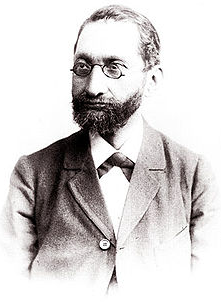
“Szymon Winawer – kupiec z Warszawy”
Taką tabliczkę zawsze stawiał na stoliku, przy którym zasiadał do gry w szachy w najróżniejszych miejscach Europy.
Swe sukcesy zawsze traktował jako osiągnięcia szachisty – Polaka.
Zaznaczał nieustannie swą przynależność do narodu polskiego, a występując za granicą z paszportem rosyjskim, niezmiennie stawiał na stoliku podczas gry wspomnianą na wstępie tabliczkę!
Argumentując, że jest Polakiem, odmówił udziału we wszechrosyjskim turnieju w Petersburgu w 1878/1879 r., do którego był oficjalnie, jako obywatel rosyjskiego imperium, zaproszony.
Karierę szachową rozpoczął w sposób niezwykły. Szachami pasjonował się od dziecka. W 1867 r. pojechał w charakterze kupca na światową wystawę do Paryża, mając zamiar załatwienia wielu zawodowych interesów.
Po przybyciu do Paryża dowiedział się o mającym mieć miejsce wielkim międzynarodowym turnieju szachowym.
Dzięki swym wpływom (czytaj: pieniądzom) został do turnieju dopuszczony. Co więcej: w czasach gdy na ówczesnej mapie politycznej nazwa “Polska” nie istniała – “załatwił”, że przy Jego nazwisku pisano “Polska”!
W turnieju, co stanowiło sensację, Szymon Winawer był drugi za I. Kolischem, a przed W. Steinitzem i G. Neumannem.
Od tego momentu, przez kilka kolejnych lat, zaczyna uczestniczyć w rozmaitych turniejach, stając sią niekwestionowanym drugim/trzecim szachistą świata końca XIX stulecia.
Po odejściu, z końcem wieku, z publicznego życia szachowego, staje się regularnym bywalcem warszawskiej “szachowej cukierni” Semadeniego [przy ul.Królewskiej-admin], gdzie wspiera młodych adeptów szachów (przeciwnikiem jego, między innymi, bywał…Bolesław Prus).
Był honorowym członkiem licznych europejskich stowarzyszeń.
Szymon Winawer (ur. 6 marca 1838 w Warszawie, zm. 29 listopada 1919 w Warszawie) – polski szachista pochodzenia żydowskiego.
http://pl.wikipedia.org/wiki/Szymon_Winawer
http://www.chessgames.com/perl/chessplayer?pid=16049
Krzysztof Pytel
Inni wybitni polscy szachiści pochodzenia żydowskiego to m.in. Akiba Rubinstein (1882-1961), Ksawery Tartakower (1887-1956), Mieczysław Najdorf (1910-1997).
//////////////////////////////////////
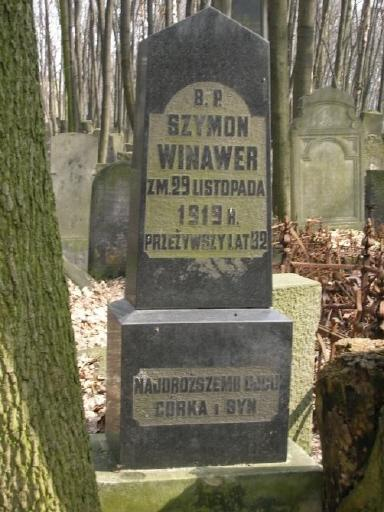
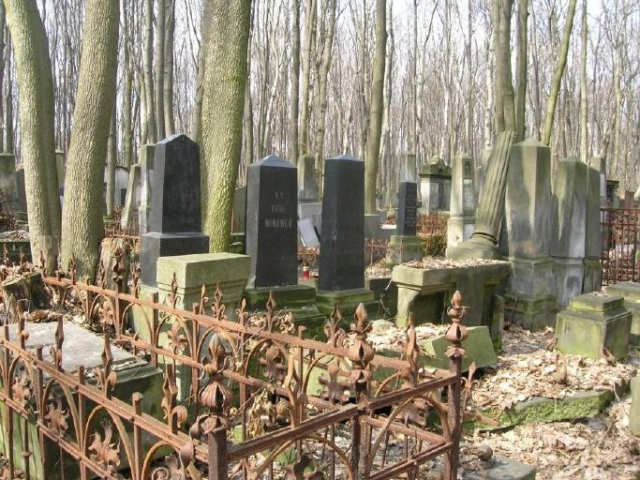
Szymon Winawer jest pochowany na cmentarzu żydowskim w Warszawie przy ulicy Okopowej. Autorem zdjęć jest Tomasz Lissowski.
Zawsze zastanawiało mnie ortodoksyjne podejście dawnych mistrzów oraz niektórych współczesnych trenerów szachowych do problemu nauki gry środkowej oraz końcówek, z jednoczesnym deprecjonowaniem debiutów. Jest to dla mnie niezrozumiałe, bo przecież w trakcie rozgrywania partii szachowej do końcówki może wogóle nie dojść, np. gdy któryś z zawodników podda się na skutek posiadania przez przeciwnika znaczącej przewagi materialnej bądź pozycyjnej. Oczywiście nie można zawsze liczyć na taką komfortową sytuację, i dlatego wobec oporu (i uporu) przeciwnika, znajomość techniki rozgrywania końcówek jest potrzebna.
Warto zauważyć, że obecnie wszyscy, a na pewno znakomita większość czołowych szachistów świata przykłada ogromne znaczenie przede wszystkim do prawidłowego przygotowania odpowiedniego dla nich repertuaru debiutowego. Nie jest to tajemnicą, zresztą zawodnicy ci otwarcie przyznają się do zaawansowanych studiów debiutowych, dzięki którym zapewniają sobie przewagę nad rywalami już w początkowej fazie partii. Skoro czołówka światowa tak intensywnie pracuje nad debiutami przynoszącymi im wymierne korzyści sportowe, to dlaczego u nas w Polsce postponuje się tą dziedzinę wiedzy szachowej? Nietrudno znaleźć w internecie wypowiedzi trenerów, którzy przyznają się do nazbyt lekkiego podchodzenia do tej fazy partii szachowej, żeby nie powiedzieć, zaniedbywania jej. Zastanawiające jest, że trenerzy ci opierają swoją postawę contra nauce debiutów, na metodach szkoleniowych stosowanych przez Marka Dworeckiego. W swojej pracy np. z młodzieżą kładą oni znaczny nacisk na naukę strategii, taktyki, gry środkowej oraz końcówek, jednocześnie otwarcie przyznając się do pomijania pracy nad repertuarem debiutowym swoich podopiecznych. A przecież bez solidnie przygotowanego zbioru otwarć szachowych, nie ma co marzyć o zdobyciu przewagi nad zawodnikami z czołowych (a nawet niższych) miejsc listy rankingowej. Zresztą warto przyglądnąć się partiom rozgrywanym przez polskich arcymistrzów przeciwko silnym graczom z zagranicy. Nasze asy często nie są w stanie „wyjść z debiutu”, gdyż już w tej fazie gry otrzymują gorszą pozycję, nie rokującą na coś lepszego niż remis.
Dlaczego więc tak często spotykamy się z oporem trenerów twierdzących, że sami zawodnicy, a także ich rodzice oraz działacze klubowi oczekują od nich przygotowania odpowiedniego repertuaru debiutowego? Myślę że te oczekiwania są efektem właściwej postawy samych zainteresowanych, podobnie jak dopatrywanie się przez nich źródeł długotrwałych niepowodzeń właśnie w braku dopracowanego zestawu debiutów. Niewątpliwie praca nad przygotowaniem odpowiedniego repertuaru otwarć jest zajęciem ciężkim i długotrwałym, wymagającym chociażby przeglądnięcia dużej ilości partii, odnalezienia ciekawych wariantów i nowinek. Co więcej, jest nieustanną twórczą pracą, gdyż wobec rozwoju teorii debiutów istnieje konieczność ciągłego poszukiwania coraz to nowych dróg ku zdobyciu przewagi w grze. Czy zatem polscy trenerzy rezygnują z tej trudnej pracy na rzecz łatwiejszej działalności szkoleniowej w zakresie gry środkowej i końcówek?
Mark Dworecki nie wierzy w fundamentalne znaczenie pracy nad debiutami. Usiłuje przekonać, że przewagę zdobywa się w grze środkowej i w końcówce. Oraz że te dwie, późniejsze fazy gry decydują o powodzeniu bądź porażce zawodnika. A co będzie, gdy szachista „polegnie” już w debiucie? Postawa Dworeckiego kłóci się z wypowiedziami arcymistrzów z czołówki światowej, którzy przykładają kluczową wagę do prawidłowo dobranego, i właściwie rozegranego debiutu, jako fundamentu wygranej partii. Ciekawi mnie też to, dlaczego tak niewiele mówią o metodach Marka Dworeckiego? Czy może uważają jego techniki szkoleniowe za przestarzałe, a jego samego za osobę nie nadążającą za zmianami w teorii szachów? Trudno mi uwierzyć, że Dworecki odkrył jedynie słuszną metodę treningu szachowego, którą należy zaakceptować jako kanon, czy wręcz dogmat. Wydaje się że rzeczywistość szachowa pokazuje co innego. Czy może jest tak, że arcymistrzowska czołówka światowa odchodzi od metod Dworeckiego, nie widząc w nich sposobu na zdobycie zdecydowanej przewagi w partii, a nasi krajowi szachiści nadal posługują się jego starymi doktrynami, przez co nie są w stanie wybić się ponad przeciętność? Problem jest dyskusyjny, i warty podjęcia szerszej polemiki z trenerami.
Interesującym i problematycznym zagadnieniem jest sposób podejścia do nauki szachów, o czym sygnalizowałem już na wstępie niniejszego artykułu. W swojej trzytomowej książce pt. „Końcówki szachowe” (wyd. Arden, Rzeszów 2001) Bogdan Zerek wspomina, iż wielcy, klasyczni mistrzowie zalecali rozpoczęcie pracy nad szachami od nauki końcówek. Ich argumentem był cel gry w szachy, czyli danie mata wrogiemu królowi. Ale w trakcie gry nie zawsze do niego dochodzi. Poza tym, czy celem partii nie jest po prostu zwycięstwo, uzyskane bądź poprzez zamatowanie króla, bądź poddanie się przeciwnika? A właściwie, dlaczego naukę szachów należy rozpocząć właśnie od końcówek? Przecież partia szachowa nie rozpoczyna się od końcówki, lecz od początkowego ustawienia bierek, których stopniowe wyprowadzenie nosi nazwę odpowiedniego debiutu. Dopiero poprzez tą wstępną fazę rozwoju, partia stopniowo przechodzi w grę środkową, a ta, przynajmniej teoretycznie, w końcówkę. Wydaje się więc, że odpowiednim i naturalnym sposobem podejścia do nauki szachów, przynajmniej na początkowym etapie, będzie położenie nacisku jednocześnie na wszystkie trzy fazy partii. Myślę, że dzięki takiemu systemowi szkolenia, uczeń będzie mógł zrozumieć rolę poszczególnych faz gry oraz sposobu przejścia od debiutu do gry środkowej i końcówki. Co więcej, zwrócenie uwagi na prawidłowy wybór debiutu oraz właściwe jego rozegranie, umożliwi szachiście zrozumienie mechanizmu uzyskania przewagi jeszcze przed etapem gry środkowej, która, być może przejdzie w końcówkę.
Podczas moich treningów pod kierunkiem mm Aleksandra Czerwońskiego http://www.konikowski.net/ciek11.php#mojkurs oczywiście ćwiczyłem rozgrywanie końcówek, ale ten punkt nauki nie był wiodący. Mój nauczyciel przywiązywał wagę do stopniowego wyćwiczenia mnie we wszystkich fazach gry. Powiem więcej, kładł spory nacisk na prawidłowy sposób rozgrywania debiutu, podkreślając że jest to bardzo ważna faza gry, umożliwiająca już na wstępie walkę o dominację na szachownicy. W trakcie nauki demonstrował mi przypadki, gdy zaniedbania w początkowej fazie gry skutkowały późniejszą przegraną, gdyż gracz nie był w stanie wzmocnić pozycji pomimo dobrej znajomości metod rozgrywania fazy gry środkowej oraz końcówki. Czyli proces nauki obejmował równolegle trzy etapy partii, ale z podkreśleniem że debiut jest niezwykle ważną jej częścią, naznaczającą pewnym „piętnem” dalszy przebieg rozgrywki. Na przykład tym piętnem poza zdobyciem bądź utraceniem przewagi jest utworzenie określonej struktury pionkowej, mającej niezwykle ważne znaczenie dla charakteru gry.
Wymienię tu przykładowe problemy debiutowe, poruszane podczas moich treningów u mm Czerwońskiego:
1. Debiut a partia jako całość. Podejście do partii szachowej jako całości, w której kolejne fazy gry logicznie wynikają z poprzednich. Wykazanie wpływu prawidłowo (albo źle) rozegranego debiutu na przebieg gry środkowej, i uzyskanie w niej przewagi bądź gorszej pozycji (przy źle rozegranym debiucie). Walka o opanowanie centrum, rozwój figur, zdobycie przewagi w debiucie, prawidłowe uproszczenie materiału w grze środkowej, prowadzące do realizacji przewagi w wygranej końcówce.
2. Ustawienie króla w debiucie. Omówienie zagadnienia prawidłowego ukrycia króla poprzez zroszowanie we właściwą stronę. Wykazanie niebezpieczeństw na jakie jest narażony monarcha, pozostający w centrum bez wykonania roszady. Sposób realizacji przewagi pozycyjnej przy braku roszady u przeciwnika. Atak na króla.
3. Naruszenie zasad w debiucie. Konsekwencje źle prowadzonego rozwoju figur, strata temp, materiału, itp.
Krzysztof Kledzik

Dear chess friends,
Below you can find the official Round 4 Report on the GRENKE Chess Classic in Baden-Baden. Please feel free to use this report and the accompanying photos on your own websites, but please link to the official website (http://www.grenkechessclassic.com) and credit Georgios Souleidis for the photos and myself (Colin McGourty) for the text.
If you’d prefer not to receive press releases from the GRENKE Chess Classic please reply to this mail with „UNSUBSCRIBE” as the subject.
Best wishes,
Colin McGourty, GRENKE Chess Classic press team
—-
Note: the full version of this report including diagrams will shortly appear on the official website
Round 4: Naiditsch bounces straight back
Where would we be without Arkadij Naiditsch? For the third day in a row his game saw a dramatic time scramble and the only decisive result on the stage of the GRENKE Chess Classic. On this occasion he emerged victorious, while Mickey Adams and Fabiano Caruana played a sharp and hard-fought draw. World Champion Viswanathan Anand was agonisingly close to a first win, but an endgame slip allowed Daniel Fridman to escape.
Fridman was mildly sceptical about Anand’s claim in the post-game press conference that he’d played the novelty 13…e5 after 5 minutes’ thought at the board. That was a deviation from a game from the recent Tashkent Grand Prix where Peter Leko played the logical 13…a4 against Alexander Morozevich only to find himself swept off the board by a ferocious kingside attack. Here Anand smothered his opponent’s play to force what he described as a “very comfortable ending”. Although the ending is Fridman’s forte time trouble and minor inaccuracies led to a position where both players acknowledged he was lost (after 48.Kb3).
The winning line was 48…Be8 49.Nf1 Ba4+ 50.Kb2 Bd1 51.Ne3 Bf3 52.Nd5 Bxe4 53.Nxf6 Bxf5 54.Kb3 bxa3 55.Kxa3 e4 56.Kb3 e3 57.Kc3 e2 58.Kd2 Bd3! and the rest is easy… Needless to say that’s still fiendishly difficult for mere mortals, but Fridman said in the press conference, “I saw it, but what can I do, it’s just only moves…”.Vishy instead played 48…Bh5? and said after Fridman’s 49.Ka2 he immediately realised the difference – White now has the d7-square. After 49…Ka4 50.Nb3 bxa3 51.Nxc5+ Kb4 White has the saving 52.Nd7! and all roads lead to a draw. It was a huge disappointment for the World Champion, who may have hoped his performance in Wijk aan Zee had put an end to the aggravating discussion about a lack of decisive results in his games.
That’s the last thing Arkadij Naiditsch has to worry about, of course. The German no. 1 has gone hell-for-leather in all his games, with unpredictable but always entertaining results. Today’s opponent Georg Meier was finally undone by his terrible handling of the clock – at one stage he had 51 seconds for 13 moves – although Naiditsch also failed to play the smoothest game of his life.
It all started with historical overtones. In 1925 Baden-Baden was the venue for one of the greatest tournament triumphs of the fourth World Champion, Alexander Alekhine, who scored 12 wins, 8 draws and no losses against a world-class field. Three years earlier in Vienna he won a fine game against Hans Kmoch by following the line Meier played today right up until move 10.
Alekhine took the white knight with his pawn – a move Houdini still approves of – while Meier went for the novelty 10…Bxe4. Alekhine followed up with 11…h5 and 12…g5 and won a crushing game, but while Meier eventually did play …h5 and even showed …h5 in combination with …g5 in the press conference (much to Naiditsch’s bewilderment), things didn’t follow the same scenario in 2013.
Naiditsch used an unprintable exclamation to express his emotions after spending 30 minutes mulling the consequences of 14.c6 Nb8!? only to see Georg Meier instantly respond 14…Nf6. That seemed to be a good practical choice, but after 15.Qxb5 a6 16.Qa4 Meier spoiled an apparently sound position with the terrible 16…Ne4?, admitting he’d “completely failed to realise” that he couldn’t follow exchanges on e4 with …f5 as d5 simply wins – Black can’t survive when White opens the d-file with a pawn on c6.
By this stage Meier was already in desperate time trouble and logically the game should simply have ended in a straightforward strategic victory, but perhaps some of the spirit of Alekhine returned as Meier seized his last chance with 20…Qh4. After 21.f4 White would be well on top, as Naiditsch realised, but he saw a “better” move: “I thought 21.h3?! was just winning the game”. He admitted he’d simply blundered that he loses the a3-bishop after 21…a5 22.Qxb5 Qg3 23.fxe4 Qxe3+ 24.Kh1 Qxa3, and was lucky that he still had 25.Qb7!
Here Meier was down to seconds and understandably missed the stunning drawing line 25…Qd6!! 26.Qxa8 Ke7 27. e5 Qxd4 28.Qxh8 (28.Rad1 Qxd1!) Qxe5! and Black’s queen and bishop give perpetual check. It still wasn’t over, as a bad case of moving the wrong rook on move 29 gave Meier much more prosaic chances of holding a draw with 29…Qxd4! but after 29.Rxd6?? 30.Rxc3 Rxd4 31.c7! the fat lady was well and truly singing. Meier said he considered resigning on the spot but then decided to show the spectators the neat 31…Rc8 32.Rb1 Rb4 33.Rd1.
The last game to finish was surely the best game of the round in terms of quality. Fabiano Caruana was back at his imperious best when it came to preparation. After 16…Bg4 Adams was on the edge of what he knew, but said he decided to be “very ambitious” and play 17.Nd5!? Caruana confirmed that novelty was a very good move, but that confirmation was the whole problem! He was prepared for the line, even if he said he hadn’t looked at it for a year. After 17…Bxf3 18.Nxb6 Bxg2 19.Kxg2 Rxb6 20.f4 Adams said it “wasn’t a very pleasant surprise” that the paradoxical 20…d5 came instantly.
Only White’s 22nd move made the young Italian stop to think, but from that point on it was a very even struggle. Adams identified 26…Rfg8 as the moment at which Caruana slipped, and thought 26…Qg5! would have been critical. After 27.Rf6! White was clearly on top, but although Adams felt White might have a win (34.h4! is the computer’s suggested improvement, though Adams wasn’t convinced when he was shown it after the game) it was very hard to prove anything. It was a game neither player deserved to lose and was eventually agreed drawn on move 50.
That leaves Caruana in the outright lead on 3/4, while Adams has mixed emotions. He’s played some of the most enterprising chess in Baden-Baden, but has only three draws and a loss to his name. As he jokingly summed it up in the press room: „A slight lack of points has been the problem. Not much has been going my way”
Full standings after 4 rounds of the GRENKE Chess Classic:
1. Caruana: 3
2. Naiditsch: 2.5
3. Anand, Fridman: 2
5. Adams: 1.5
6. Meier: 1
The key showdown in Monday’s round 5 looks set to be Anand – Naiditsch.
The full pairings are:
Caruana – Fridman
Meier – Adams
Anand – Naiditsch
Follow the live coverage on the GRENKE Chess Classic website from 15:00 CET: http://live.grenkechessclassic.com
Report: Colin McGourty Photos: Georgios Souleidis